
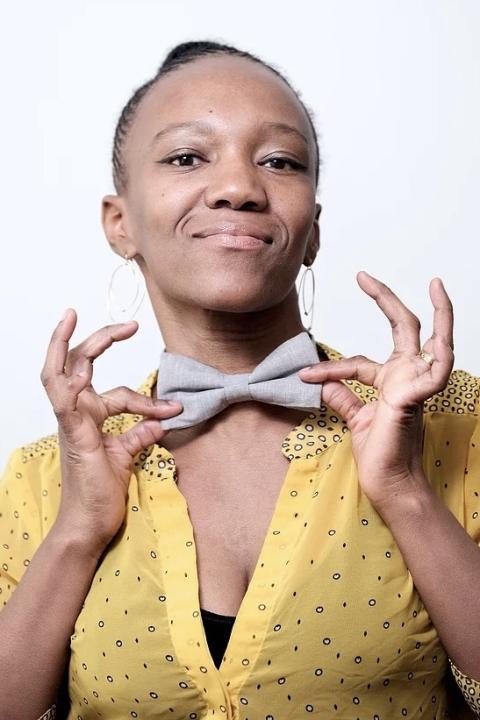
Goussy Célestin
For media inquiries, please contact Media Relations
Haitian-American artist Goussy Célestin is a pianist, composer, arranger, vocalist, and dancer with a decades-long career of engaging audiences globally. Célestin's personal mission is to stir up all of her musical influences into a moving experience, incorporating jazz elements and dance influences.
She has studied and performed music and dance with such esteemed names as Ron Carter, Jimmy Heath, C. Scoby Stroman, Max Roach, Donald Byrd, Barry Harris, and Sheila Jordan as a jazz pianist-vocalist, while studying with Pat Hall, Jean Leon Destiné, and Camille Yarbrough as a dancer. She’s been a featured vocalist for Rattlestick Theater, and has led workshops at the Metropolitan Opera's 2019 National Educators Conference, The Mile Long Opera, and Met Opera's Global Summer Camp. She has also led music workshops at Bobby McFerrin’s CircleSongs School and currently is a senior manager for jazz at the Lincoln Center's WeBop program.
Célestin is an alum of ASE Dance Theater Collective, a neo-folklore ensemble dedicated to the traditional/contemporary arts of the African Diaspora filtered through Haitian music and dance. While in Cuba, she had the honor of performing with members of the Buena Vista Social Club, as well as performing/mentoring with members of Grupo AfroCuba de Matanzas, Yoruba Andabo, and Clave Y Guaguanco. She has performed at Alice Tully Hall, Lincoln Center, Del Terzo Studio at Carnegie Hall, Symphony Space, SOB's, the Knitting Factory, NJPAC, Tilles Center, Newark Symphony Space, and Joe's Pub, as well as various jazz clubs in New York City. Goussy's musical travels include Japan, England, Wales, Cuba, the British Virgin Islands, and Haiti, as well as touring parts of the US.
Her current project, Goussy Célestin’s Ayiti Brass is an eight-member ensemble that incorporates sound and movement, inspired by New Orleans’ second-line and Haiti’s Rara and African-American jazz traditions.
- Premiered KongoNola Project at Inaugural Nomad Jazz Festival, 2025
- Off Broadway credits: Novenas for a Lost Hospital; City of No Illusion; How We Are Connected
- Performed at the sixth-annual Jazz on the Hill, as well as the British Virgin Islands Jazz Festival and Festival Internationale du Jazz in Port-Au-Prince
- Studied and performed with Barry Harris, Bobby McFerrin, Jimmy Heath, and Jon Hicks
- Brooklyn Conservatory of Music—Jazz Leaders Fellowship, 2024
- Berklee NYC Faculty Recording Grant, 2023
- NYC Women's Fund, 2023
- New York State Council on the Arts Support for Artists, 2023
- American Composers Forum, Innova Records Spring National Call, 2022
- Laundromat Project, Create Change Fellow, 2017
- Queens Council on the Arts, New Work Grant, 2017
- Gardarev Resident Artist Fellow, 2016
- Field Leadership Artist Fellow, 2015–2017